Bearing Materials: GCr15 Bearing Steel and International Grades
Bearing steel is one of the fundamental materials used in rolling bearings. The quality of the steel directly affects bearing hardness, wear resistance, contact fatigue performance, dimensional stability, and service life.
Among the most widely used bearing steels is GCr15, a high-carbon chromium bearing steel commonly used for bearing rings, balls, rollers, and other rolling-contact components.
For international customers, GCr15 may appear under different designations depending on the applicable national or regional standard. Understanding these designations helps buyers communicate material requirements clearly when sourcing bearings internationally.
What Is GCr15 Bearing Steel?
GCr15 is a high-carbon chromium bearing steel specified in the Chinese GB/T 18254 standard for high-carbon chromium bearing steel.
Its key chemical composition characteristics include:
| Element | GCr15 |
|---|---|
| Carbon (C) | 0.95–1.05% |
| Chromium (Cr) | 1.40–1.65% |
The relatively high carbon content contributes to the hardness and wear resistance required in rolling bearings, while chromium improves hardenability and contributes to the material’s overall performance after heat treatment.
GCr15 is widely used in the production of bearing rings, rolling elements, and other precision components requiring high hardness, wear resistance, and resistance to rolling contact fatigue.
GCr15 and International Bearing Steel Grades
Different countries and standards use different designations for bearing steels with closely comparable chemical compositions and applications.
The following table shows commonly referenced bearing steel grades corresponding to or comparable with GCr15:
← Swipe to view full table
| Standard / Country | Bearing Steel Grade | Carbon (C) | Chromium (Cr) |
|---|---|---|---|
| China – GB/T 18254 | GCr15 | 0.95–1.05% | 1.40–1.65% |
| ISO | 100Cr6 | 0.95–1.05% | 1.40–1.60% |
| Germany – DIN | 100Cr6 | 0.95–1.05% | 1.40–1.60% |
| Japan – JIS | SUJ2 | 0.95–1.05% | 1.30–1.60% |
| USA – ASTM/AISI | 52100 | 0.98–1.10% | 1.30–1.60% |
| France – NF | 100Cr6 | 0.95–1.05% | 1.40–1.60% |
| Russia – ГОСТ | ШХ15 | 0.95–1.05% | 1.40–1.60% |
| South Korea – KS | STB2 | 0.95–1.05% | 1.30–1.60% |
Important Note on Equivalent Grades
These grades are commonly referenced as equivalent or comparable bearing-steel designations in international bearing manufacturing.
However, an equivalent designation does not necessarily mean that every technical requirement is identical across different standards. Chemical composition ranges, cleanliness requirements, metallurgical requirements, heat-treatment specifications, and inspection requirements may vary between standards.
For this reason, material requirements should always be confirmed against the applicable standard and customer specification.
Why Is GCr15 Widely Used for Bearings?
GCr15 has become one of the most widely used bearing steels because its composition and heat-treatment characteristics are well suited to rolling-contact applications.
High Hardness
After appropriate heat treatment, GCr15 can achieve the high hardness required for bearing rings and rolling elements.
High hardness helps bearing components resist deformation and wear under repeated rolling contact.
Wear Resistance
Bearing components are continuously subjected to rolling and sliding contact. The high-carbon chromium composition of GCr15 provides the material characteristics required for good wear resistance after heat treatment.
Contact Fatigue Resistance
Rolling bearings experience repeated contact stress throughout their service life.
The material’s microstructure, hardness, cleanliness, and heat-treatment quality all contribute to its resistance to rolling contact fatigue.
Hardenability
Chromium improves the hardenability of the steel, allowing the material to develop the required hardened structure during heat treatment.
Dimensional Stability
Bearing components require high dimensional and geometric accuracy. Material quality and heat-treatment control are therefore important factors in maintaining dimensional stability during bearing production.
Bearing Steel Quality Is More Than Chemical Composition
When evaluating bearing steel, chemical composition is only one part of the picture.
For bearing applications, the quality of the steel also depends on metallurgical cleanliness and structural characteristics, including:
- Non-metallic inclusions
- Carbide distribution
- Microstructure
- Decarburization control
- Steel cleanliness
- Heat-treatment response
These factors can have a significant influence on bearing fatigue life, reliability, and operating stability.
For precision bearing applications, controlling the quality of the raw steel is therefore an important part of the overall manufacturing process.
Heat Treatment of GCr15 Bearing Steel
Heat treatment is essential for developing the properties required from GCr15 bearing steel.
A typical heat-treatment process may include:
Spheroidizing Annealing → Hardening → Low-Temperature Tempering
Spheroidizing Annealing
Spheroidizing annealing prepares the material’s microstructure and improves machinability before the subsequent hardening process.
Hardening
Hardening develops the high-hardness structure required for bearing components and provides the foundation for their wear resistance and rolling contact fatigue performance.
Low-Temperature Tempering
Low-temperature tempering helps reduce internal stresses after hardening and stabilizes the hardened structure while maintaining the high hardness required for bearing applications.
The actual heat-treatment process and parameters depend on the steel condition, component design, production process, and applicable technical requirements.
Bearing Steel Quality Control
High-quality bearing steel requires more than simply meeting a nominal chemical composition.
Depending on the material specification and production requirements, bearing steel may be evaluated through different inspection and testing methods, such as:
- Chemical composition analysis
- Hardness testing
- Metallographic examination
- Carbide distribution inspection
- Non-metallic inclusion evaluation
- Ultrasonic testing
- Decarburization inspection
These controls help identify potential material defects and verify that the steel is suitable for demanding bearing applications.
RIVER BEARING Bearing Steel Sourcing
We believe consistent bearing performance starts with reliable bearing steel.
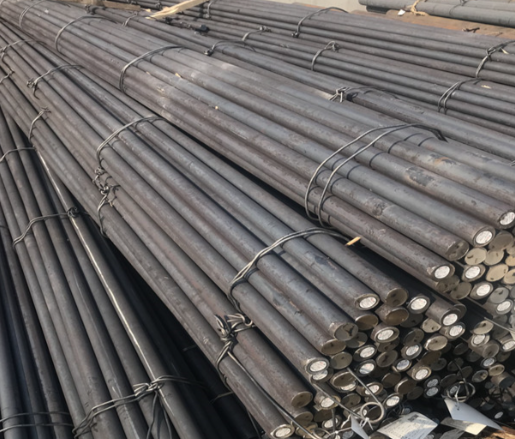
For standard bearing applications, RIVER BEARING uses established bearing steel grades such as GCr15 and their commonly recognized international equivalents.
We source bearing steel from major Chinese steel groups with established steelmaking capabilities and quality-control systems.
The quality of the raw steel is a fundamental part of bearing manufacturing. Reliable steel helps provide a stable foundation for the subsequent processes of forging, turning, heat treatment, grinding, assembly, and final inspection.
For this reason, RIVER BEARING pays close attention to the source and quality of the bearing steel used in production.
Our goal is not simply to supply bearings with the correct designation. We focus on using reliable raw materials and established manufacturing resources to support consistent bearing quality and performance for industrial customers.
From Bearing Steel to Finished Bearing
Bearing performance is the result of multiple manufacturing stages working together.
The quality of the raw material provides the foundation, while controlled manufacturing processes determine the final performance of the bearing.
This is why material quality should be considered together with heat treatment, dimensional accuracy, surface finish, lubrication, assembly, and final inspection.
How RIVER BEARING Approaches Bearing Quality
As a bearing manufacturer, RIVER BEARING considers raw material quality an essential part of the manufacturing process.
From the selection of bearing steel and control of incoming materials to heat treatment, machining, grinding, assembly, and final inspection, each stage can affect the consistency and performance of the finished bearing.
For this reason, we pay close attention to:
Bearing steel quality and material source
Manufacturing process control
Heat treatment
Dimensional accuracy
Surface finish
Assembly quality
Final inspection
Reliable raw materials are an important starting point, but consistent bearing performance depends on the control of the entire manufacturing process.
Need Help Finding Bearings Made from Reliable Bearing Steel?
Looking for reliable Chinese bearings for your industrial application? Tell us your bearing type, size, application, quantity, and quality requirements.