Deep Groove Ball Bearings: Structure, Features, Selection and Applications
Deep groove ball bearings are the most widely used rolling bearings in modern machinery. They have continuous deep-groove raceways in the inner and outer rings, allowing them to support radial loads and limited axial loads in both directions. Their simple structure, low friction, high-speed capability, versatility, and economical design make them suitable for a wide range of rotating equipment.
What Is a Deep Groove Ball Bearing?
A deep groove ball bearing is a rolling bearing with continuous deep-groove raceways in the inner and outer rings. It carries radial loads and limited axial loads in both directions.
Basic Structure
A deep groove ball bearing mainly consists of four basic components: the inner ring, the outer ring, the rolling elements (steel balls), and the cage/retainer. Depending on the design, seals or shields may also be included. The bearing shown above is an open type, so it has no seals or shields. Closed types add seals or shields to protect against contamination and retain lubricant.
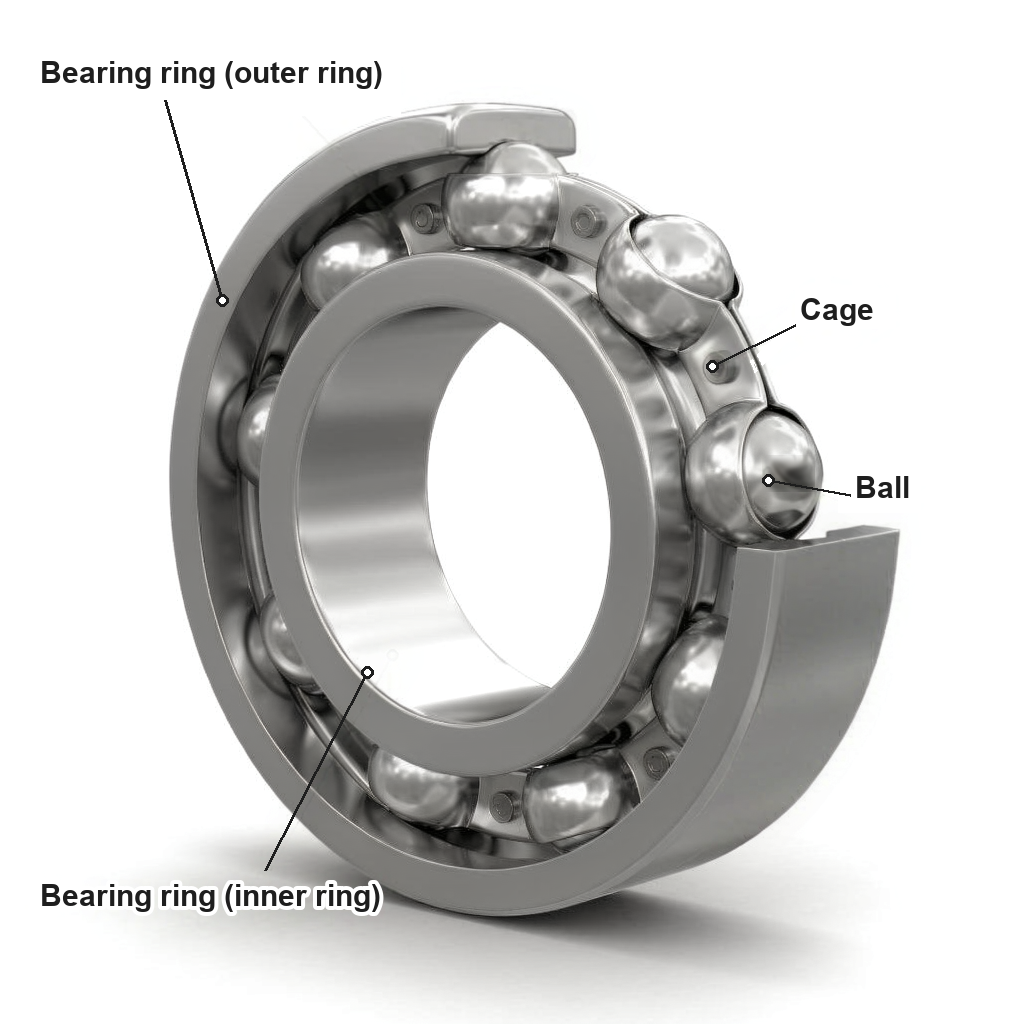
1. Inner and Outer Rings
The inner and outer rings contain the deep-groove raceways that guide the steel balls and carry the applied loads.
2. Rolling Elements (Steel Balls)
The steel balls roll between the inner and outer raceways to transfer loads while reducing friction compared with sliding contact.
3. Cage / Retainer
The cage separates and guides the steel balls, helping maintain even spacing and reducing direct contact between adjacent balls.
4. Seals / Shields (Optional)
Depending on the application, deep groove ball bearings may be supplied as open bearings (without seals or shields), with rubber seals (2RS), or with metal shields (ZZ)..
Structural Advantages
- Simple and compact design
- Low friction
- Easy to manufacture with high precision
- Suitable for high-speed rotation
- Versatile for a wide range of industrial applications
Key Performance Features
1. High-Speed Capability
Low friction and relatively low rotational resistance allow deep groove ball bearings to operate at high speeds, making them widely used in motors, fans, blowers, and other rotating equipment.
2. Low Noise and Smooth Operation
Proper raceway geometry, precision manufacturing, and controlled internal components contribute to smooth rotation and low noise. This is particularly important for electric motors, office equipment, and precision machinery.
3. Easy Maintenance
Sealed bearings can help retain grease and prevent the entry of dust and contaminants, reducing the need for routine relubrication in many applications.
4. Cost-Effective
Their simple and standardized design allows efficient mass production, making deep groove ball bearings an economical solution for a wide range of industrial applications.
5. Load Adaptability
Deep groove ball bearings primarily support radial loads and can also accommodate axial loads in both directions. However, their axial load capacity is generally lower than their radial load capacity.
How Does a Deep Groove Ball Bearing Work?
Load Transfer
The steel balls roll along the raceways of the inner and outer rings, transferring radial and axial loads through rolling contact.
Rolling Friction
Deep groove ball bearings reduce friction by replacing most sliding contact with rolling contact between the balls and raceways. This helps reduce frictional losses during rotation.
Cage Function
The cage keeps the steel balls evenly spaced, helps guide their movement, and reduces direct contact between adjacent balls.
Misalignment
Deep groove ball bearings can tolerate a small degree of shaft-to-housing misalignment. However, excessive misalignment or uneven loading can increase internal stress and reduce bearing service life.
Selection and Maintenance
Selection Factors
When selecting a deep groove ball bearing, consider the following factors:
- Load: radial load, axial load, and their ratio
- Speed: required operating speed and limiting speed
- Temperature: operating temperature and heat generation
- Environment: dust, moisture, corrosion, and cleanliness
- Lubrication: grease or oil requirements
- Sealing: open, shielded, or sealed configuration
Maintenance Tips
Sealed Bearings
Sealed bearings are generally supplied with grease and do not normally require additional lubrication during their intended service life.
Open Bearings
Open bearings require an appropriate lubrication method and periodic relubrication according to the operating conditions.
Installation
Correct installation is important. Excessive force, improper fits, or excessive misalignment can lead to premature bearing failure.
Common Applications
Deep groove ball bearings are widely used because of their simple design, high-speed capability, and versatility.
- Electric motors
- Fans and blowers
- Pumps
- Gearboxes
- Household appliances
- Office equipment
- Industrial machinery
- Automotive components
- Agricultural machinery
- General rotating equipment
Conclusion
Deep groove ball bearings remain one of the most widely used bearing types in mechanical systems. Their simple structure, low friction, high-speed capability, load adaptability, and economical design make them suitable for a broad range of rotating equipment.
Proper bearing selection should consider the load, speed, temperature, environment, lubrication, and sealing requirements of the application. Choosing the appropriate bearing design and quality level can help improve operating reliability and service life.
Looking for the Right Deep Groove Ball Bearing?
Tell us about your load, speed, operating conditions, and application requirements.