Bearing Clearance: Radial and Axial Internal Clearance Explained
1. Bearing Clearance Definition
Radial Clearance
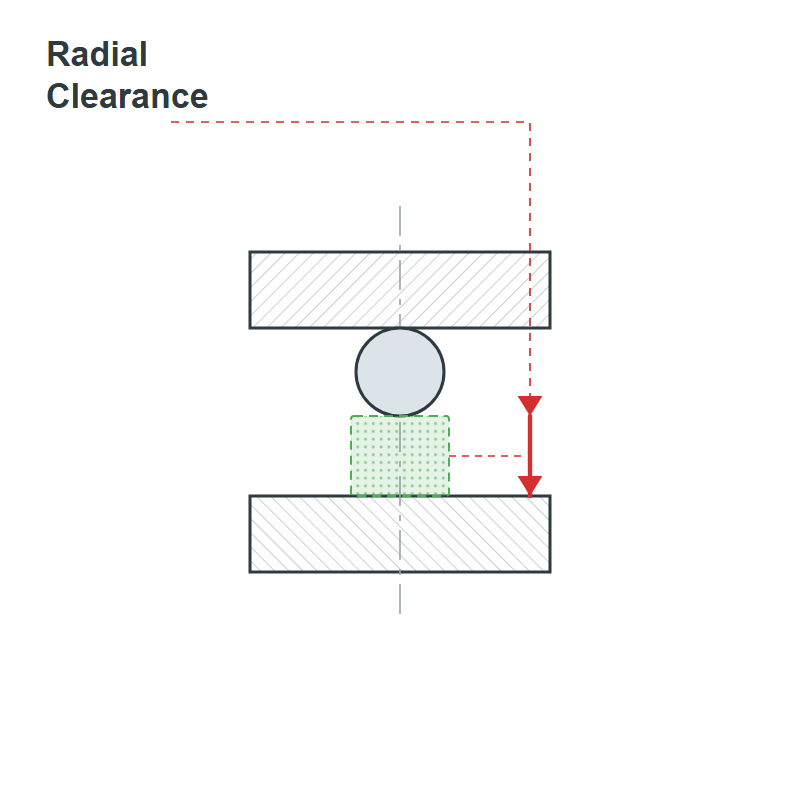
Radial clearance refers to the total distance that one bearing ring can move relative to the other in the radial direction when no load is applied.
It represents the internal gap between rolling elements and raceways, directly influencing bearing noise, vibration, temperature rise, and service life.
Axial Clearance
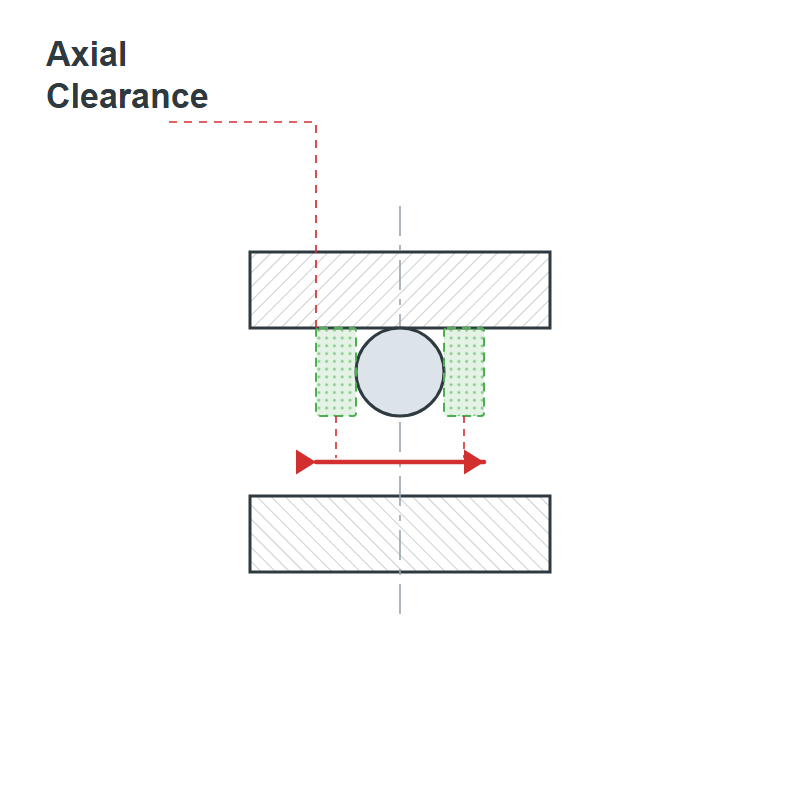
Axial clearance refers to the total distance that one bearing ring can move relative to the other along the shaft direction under no load.
It affects axial positioning accuracy and system stability.
In practice, clearance directly affects bearing performance such as fatigue life, temperature rise, noise, and vibration.
2. Importance of Bearing Clearance
Internal clearance is a critical parameter in rolling bearing applications. Different clearance values significantly affect bearing performance, especially vibration and noise, as well as operating temperature and service life.
If clearance is too large:
- Reduced load-carrying contact area
- Increased contact stress
- Shortened fatigue life
- Lower running accuracy
- Higher vibration and noise
If clearance is too small:
- Possible negative clearance (preload) during operation
- Increased friction and heat generation
- Rising temperature leading to further clearance reduction
- Risk of bearing seizure
Therefore, the correct clearance class must be selected according to operating conditions.
3. Bearing Clearance Codes
Radial internal clearance is classified into the following standard groups:
- C0: Normal clearance (default, most commonly used)
- C2: Smaller than normal clearance
- C3: Greater than normal clearance
- C4: Greater than C3 clearance
- C5: Greater than C4 clearance
4. Standard Radial Clearance Table
Interval definition: (2.5, 10] means greater than 2.5 mm and up to and including 10 mm; the value 10 belongs to this range.
Unit: μm
← Swipe to view full table
| Bore Range (mm) | C2 | Normal (C0) | C3 | C4 | C5 | |||||
|---|---|---|---|---|---|---|---|---|---|---|
| Min | Max | Min | Max | Min | Max | Min | Max | Min | Max | |
| (2.5, 10] | 0 | 7 | 2 | 13 | 8 | 23 | 14 | 29 | 20 | 37 |
| (10, 18] | 0 | 9 | 3 | 18 | 11 | 25 | 18 | 33 | 25 | 45 |
| (18, 24] | 0 | 10 | 5 | 20 | 13 | 28 | 20 | 36 | 28 | 48 |
| (24, 30] | 1 | 11 | 5 | 20 | 13 | 28 | 23 | 41 | 30 | 53 |
| (30, 40] | 1 | 11 | 6 | 20 | 15 | 33 | 28 | 46 | 40 | 64 |
| (40, 50] | 1 | 11 | 6 | 23 | 18 | 36 | 30 | 51 | 45 | 73 |
| (50, 65] | 1 | 15 | 8 | 28 | 23 | 43 | 38 | 61 | 55 | 90 |
Important Note on Clearance Ranges
Bearing clearance classes are defined as range intervals, not fixed values. As a result, there is often overlap between adjacent clearance groups.
For example, for a 10 mm bore bearing:
- C0 (Normal): 2 – 13 μm
- C3: 8 – 23 μm
The range 8 – 13 μm exists in both C0 and C3 classifications.
This means clearance selection depends not only on numerical values, but also on actual operating conditions such as fit, temperature, and load.
← Swipe to view full chart
5. Clearance Selection Guide
← Swipe to view full table
| Operating Conditions | Typical Applications | Recommended Clearance |
|---|---|---|
| 1. Precision fit or non-interference fit 2. Strict noise and vibration control 3. High positioning accuracy required | Test equipment, instruments, low-noise motors, precision rolling mills | C2 |
| 1. General fit conditions 2. Normal load and speed 3. Moderate temperature rise | General machinery, gearboxes, transmission systems | C0 |
| 1. Interference fit on inner or outer ring 2. Poor heat dissipation of inner ring 3. Variable load conditions | Railway vehicles, paper machines, mining equipment | C3 |
| 1. Heavy interference fit 2. High operating temperature 3. Misalignment or angular conditions | Vibrating screens, dryers, automotive rear wheels | C4 |
| 1. Very heavy interference fit 2. High temperature and poor heat dissipation | Vibratory rollers | C5 |
Need Help Selecting the Right Bearing Clearance?
Tell us your application, speed, temperature, and fit conditions — our team will recommend the most suitable clearance class and bearing solution for you.